
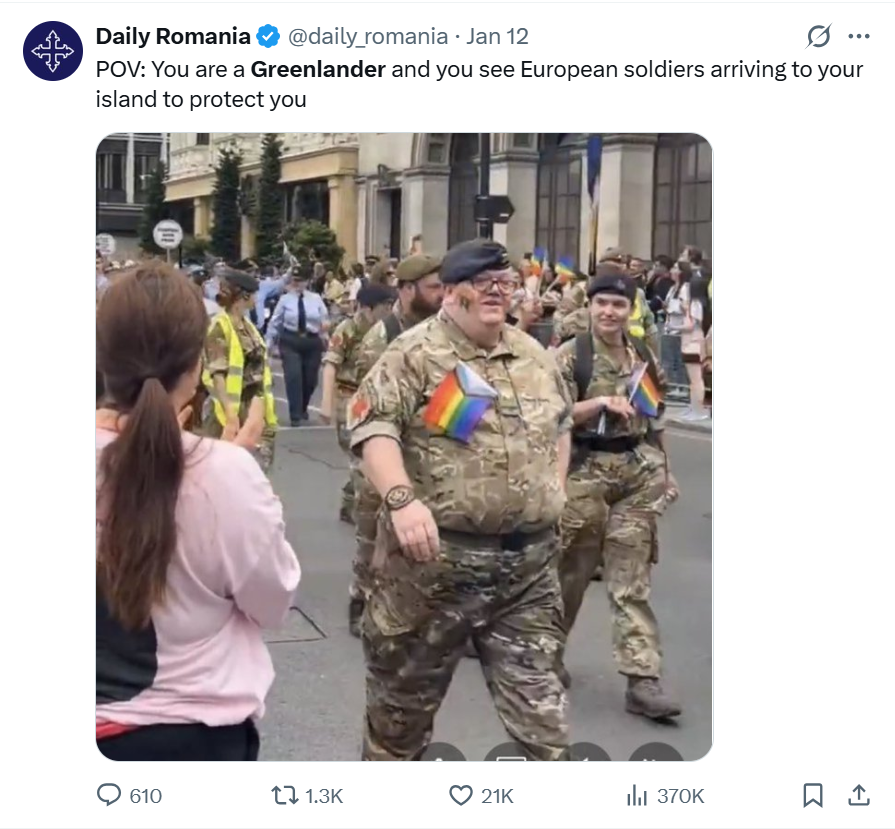
I was recently perusing X (formerly Twitter) when I happened upon a post featuring the rather catchy caption: “POV: You are a Greenlander and you see European soldiers arriving to your island to protect you.” (For the uninitiated, POV stands for Point of View).
The engagement metrics were, frankly, staggering: 600 comments, 1,300 reposts, 21,000 likes, and a total reach of 370,000. Quite an impact, wouldn’t you agree?
Image Source: Daily Romania on X
Disinformation and the protection of truth online
At first glance, the post appears entirely credible, yet as the saying goes, the devil is in the detail. One might ask: why is there someone in the background who bears a striking resemblance to a British police officer or a security guard?
A brief OSINT (Open Source Intelligence) investigation quickly clarifies the matter. This image was not captured in Greenland; rather, it was taken in London in 2025, depicting cadets participating in a Pride Parade.
This serves as a textbook example of how easily a fabricated context can infect public discourse. The narrative even reached the Polish platform Wykop, while the account responsible for the original post, “Daily Romania,” openly identifies with the bio: Nationalism | Romania & Europe.
Strategic defence against manipulation – lessons from OSINT
Has disinformation truly gained such a foothold that we have surrendered our capacity for basic fact-checking? In a world where any image can be instantly stripped of its context and broadcast to thousands, our primary line of resistance is critical thinking supported by the rigorous craft of OSINT.
Analysing this alleged “Greenland deployment” teaches us three fundamental principles of modern information protection:
- The ‘Cool-headed’ principle: Disinformation thrives on emotion – be it fear, national pride, or a perceived threat. This case reminds us that when a piece of content provokes a strong emotional response, one must take a step back. The initial instinct should not be to “Share,” but to “Verify.”
- Visual Investigation (Contextual verification): In the aforementioned photograph, a single detail -the presence of colourful flags – was enough to dismantle the entire narrative. Learning to recognise such nuances (licence plates, architecture, insignia) is the cornerstone of defending against visual manipulation.
- Digital Provenance: Tools such as Reverse Image Search allow us to discover in mere seconds that “breaking news” from today is, in fact, a photograph from a different corner of the globe taken years ago. It is perhaps the simplest, yet most effective filter for the truth.
Why this matters for your organisation
In a corporate environment, disinformation extends far beyond the realm of politics. It manifests as fake news targeting brand reputation, manipulated market data, or sophisticated fraud attempts based on fabricated identities. Mastering OSINT techniques allows employees to become a “human firewall” for the organisation.
Rather than being passive consumers of information noise, we can become active analysts capable of distinguishing carefully orchestrated manipulation from hard facts. Today, defending against disinformation is not a luxury; it is a matter of fundamental digital hygiene.
If you are looking to booster your organisation’s resilience against manipulation, or if you are curious about how OSINT techniques can empower your team, I invite you to a complimentary, 15-minute virtual coffee. It is an entirely non-committal way to discuss your training requirements and explore how I might be of assistance.
Simply click the button below to select a time that suits your schedule.
